Kharkhorin
Kharkhorin
Kharkhorin, known by its historical name Karakorum, was the capital of the Mongol Empire in the 13th century.
Kharkhorin, known by its historical name Karakorum, was the capital of the Mongol Empire in the 13th century. Nestled in the Orkhon valley, approximately 370 km southwest of Ulan Bator, this small town concentrates exceptional heritage: the remnants of the imperial city and the Erdene Zuu monastery, Mongolia's first major Buddhist monastery. It is one of the rare places where nomadic and sedentary history can still be read in the landscape.
Practical Information at a Glance
Access from Ulan Bator: asphalt road then tracks, travel by 4×4 vehicle or long-distance bus (approximately 6 to 8 hours depending on conditions).
Recommended duration: 1 to 2 days to combine the museum, Erdene Zuu and the surroundings of the Orkhon valley.
Dress code: cover shoulders and knees to enter the temples of Erdene Zuu.
Accommodation: yurt camps and small hotels available on site.
What to See
The Karakorum archaeological site itself is largely buried underground; only a few stone turtles (stone turtle sculptures marking ancient quarters) emerge from the ground. The Kharkhorin museum displays objects excavated from the site: ceramics, coins, tools and models reconstructing the medieval city. A few steps away, the Erdene Zuu monastery dominates the landscape with its 108 white stupas aligned along an enclosure wall nearly a kilometer long.
History and Context
Ögedei Khan, son of Genghis Khan, founded Karakorum around 1235 as the administrative capital of the Mongol Empire. The city then welcomed artisans, merchants and diplomats from Central Asia, China and Europe. The Franciscan monk William of Rubruck visited it in 1254 and left a detailed description. After the capital was moved to Khanbaliq (Beijing) by Kublai Khan, Karakorum declined. Ming Chinese troops razed it in 1388. The stones were later used to build Erdene Zuu from 1586 onwards.
Highlights of Your Visit
Erdene Zuu Monastery
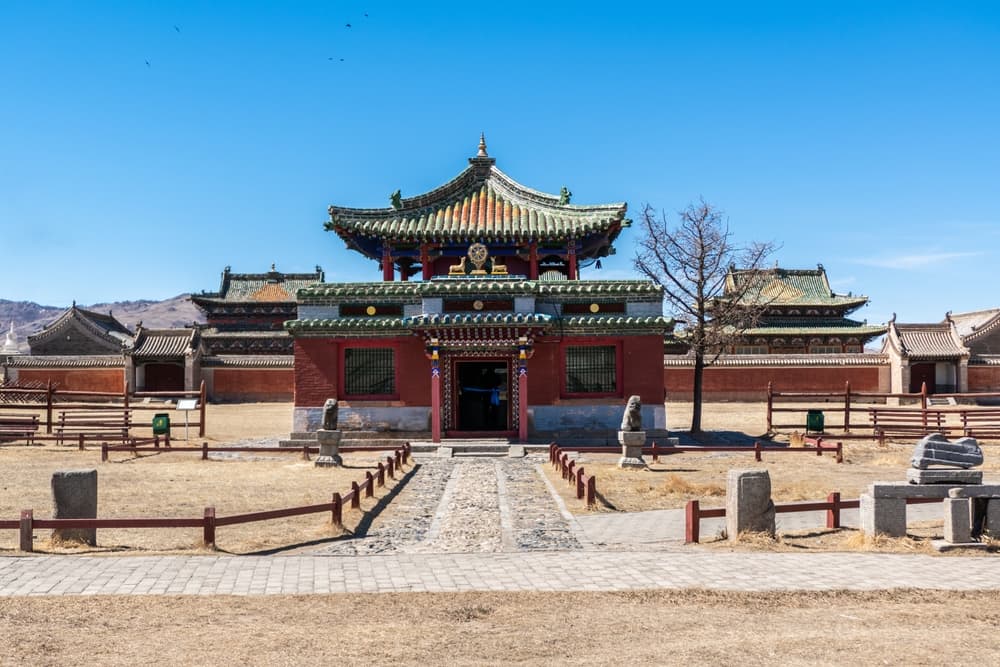
Founded in 1586 by Abtai Sain Khan, Erdene Zuu is Mongolia's first Tibetan Buddhist monastery. Its square enclosure, punctuated by 108 stupas, contains three main temples still standing after Soviet destructions in the 1930s. The interior frescoes and statues bear witness to refined religious art. The site is listed as UNESCO world heritage as part of the cultural landscape of the Orkhon valley.
The Stone Turtles
Four granite turtle sculptures once marked the angles of the imperial city. Two are still visible near the monastery. These symbolic guardians of the ancient capital constitute the most tangible surface remnants of Karakorum.
Kharkhorin Museum
Inaugurated in 2011 with support from Japanese cooperation, this modern museum presents the results of German-Mongolian excavations conducted since the 1990s. The collections illustrate daily life, trade and craftsmanship of the medieval capital.
Etiquette and Visit Rules
Remove your shoes before entering the temples of Erdene Zuu.
Cover shoulders and knees; avoid light clothing.
Circulate clockwise around the stupas and temples (Buddhist tradition).
Ask permission before photographing monks or ceremonies.
Speak softly inside the temples.
Photography Tips
Morning light is ideal for photographing the row of white stupas at Erdene Zuu with mountains in the background. In late afternoon, low-angle light enhances the relief of the stone turtles. Photography is permitted within the monastery enclosure, but is often subject to a fee or restricted inside temples — check on site.
Location and Access
Kharkhorin is located in Övörkhangaï province, in the Orkhon valley. The road from Ulan Bator is partly asphalt; a 4×4 vehicle is still recommended, especially outside the season. Long-distance buses connect the capital to Kharkhorin. The town is also a natural stop on Orkhon valley circuits, which lead to the Orkhon falls and national park landscapes.
Nearby
Orkhon Valley — UNESCO-listed steppe and river landscape, ideal for horseback trekking.
Orkhon Falls (Ulaan Tsutgalan) — volcanic waterfall accessible by 4×4 from Kharkhorin.
Tuvkhun Monastery — hermitage perched in the Khangai mountains, founded by Zanabazar in the 17th century.
Khotont Region — open steppe with traditional yurt camps and authentic nomadic life.
Frequently Asked Questions
Domande frequenti
From June to September, the steppe is green and roads are passable. July coincides with the Naadam festival, celebrated locally. Avoid November to April: extreme temperatures and difficult roads.
Yes. Cover your shoulders and knees, remove your shoes before entering the temples. A lightweight scarf or jacket is sufficient in summer.
Yes, this is the classic itinerary. From Kharkhorin, travel up the valley by 4×4 towards the Orkhon falls and yurt camps. Allow 2 to 4 additional days.
Photography is generally permitted in the outer enclosure. Inside the temples, it may be subject to an additional fee or prohibited — inquire at the entrance.
A full day covers the museum, Erdene Zuu and the stone turtles. Two days allow you to explore the immediate surroundings of the valley by horse or vehicle.
Tourist yurt camps and a few small hotels are available in town and in the valley. Advance booking is recommended during high season (July-August).
Vuoi scoprire questa destinazione?
I nostri consulenti locali creano il tuo viaggio su misura.