Hockey in Mongolia
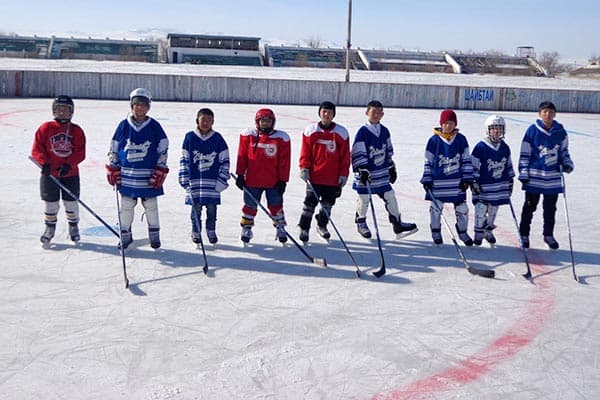
Canadians are contributing to the development of hockey in a foreign country. The Sharks team members play wearing their "Grimsby Old timers" jerseys on the slopes of frozen hills on the outskirts of Zuunmood, Mongolia.
23 Jan. 2012 Canadians are contributing to the development of hockey in a foreign country. The members of the Sharks team play wearing their "Grimsby Old timers" jerseys on the slopes of frozen hills on the outskirts of Zuunmood, Mongolia.
The Sharks use equipment donated by Canada and Finland, including jerseys and skate sharpeners from L.T. Sport in Grimsby. On a frigid December morning, on an outdoor rink at the edge of the city, the Sharks take to the ice for practice. The team, mostly young boys and teenagers, lace up their skates and courageously face -30°C windy conditions to take part in this sport of great importance to Canadian culture. It's a scene repeated daily in every Canadian community during winter. Except these children are not Canadian, and this rink couldn't be located further from Canada. The Sharks play in Zuunmod, a village of 14,000 inhabitants located 40 kilometres south of Ulaanbaatar, the capital of Mongolia.
Hockey is a relatively new sport in Mongolia. It was introduced to the country by the Russians in the 1960s, during the period of the Mongolian People's Republic. When communists were ousted from power in 1990, Russian support for hockey among Mongols declined considerably. In recent years, interest in the sport has begun to develop, thanks to equipment donations and coaching support from foreign visitors. Ryan van Geest, originally from Grimsby, is one of them. Van Geest and his family have lived in Mongolia for the past three years, where he works as a pilot for a Christian organization, the Mission Aviation Fellowship. "During the summers, as a pilot, I'm very busy flying our Cessna Caravan for poor people, missionaries, humanitarian organizations, tourists, medical emergencies and miners. During the winters, with colder temperatures, we don't have as many flights and so I have more time for hockey," he said. Van Geest became involved in local hockey after meeting some Finnish missionaries who were building a church in Zuunmod. They had constructed an outdoor rink, and with the help of van Geest and another Finnish missionary pilot, they were able to collect about 20 hockey sticks.
"Juuso (the Finnish pilot) and I brought hockey sticks for some of the children and showed them how to play hockey. They picked it up very quickly and really enjoyed it"
van Geest said.
About 15 children came to weekly training sessions. As training became popular, organizers encountered some unique challenges. Most Mongols are herders, and even in cities, more than a third of the population lives in poverty. Residents stole wooden boards to burn as firewood. The boards around the rink in Zuunmood are now made of cement. Another challenge has been finding a supply of equipment. There are no local producers of consumer goods such as hockey equipment here. According to van Geest, Russian equipment is expensive, and Chinese equipment can't withstand the harsh weather and rough play on a Mongolian rink. Children must rely on donations or homemade equipment. "Many young people make their own equipment, including goalie gear, and hockey sticks from metal and wood," van Geest said, adding that many teams made do with half-blades and repaired broken sticks. In 2010, van Geest and others were able to acquire enough equipment donated by Canada and Finland to outfit an entire team. L.T. Sport in Grimsby provided enough jerseys for three teams, and "magic sticks" for sharpening skates. The Zuunmod Sharks were born. Their practices and tournaments are now organized by Mendee, a local pastor. The Sharks participated in their first tournament in 2010... and finished last. This didn't dampen their enthusiasm for the sport. "They had a lot of fun and learned a great deal. The tournament was about eight hours away by van and it was a great opportunity for the kids to learn more about hockey and get to know their teammates better," van Geest said. The Sharks now have practice four times a week to prepare for the next tournament. He believes that introducing hockey to children in this small town on the other side of the world has been a blessing for them, as well as for himself.
Charlène Nomadays Early SEO writer at Nomadays, now content manager and head of the communications department, Charlène has accompanied the adventure from its beginnings with passion and loyalty. After living seven years in Asia – from China to Thailand, passing through Mongolia and South Korea – she has made travel a way of being in the world. A lover of words, nature and human connection, she strives to convey in her writing a sensitive, committed and responsible vision of tourism. Each article is for her a bridge between curiosity, respect and wonder.